

Herbaceutikals are small batch, hand poured, natural skin and body products for the whole family. Our crafts are made from fair trade organic materials and herbs wild-crafted here in rural Kent Lakes, New York.
Showing posts with label forage. Show all posts
Showing posts with label forage. Show all posts
Tuesday, September 15, 2015

Sunday, August 23, 2015
Late Summer Forage
In this short video I examine a few wild edibles found on a roadside in New York State. After watching I realize how little I covered on but at the same time there is so much to say about each plant as far as it's applications, uses of each plant part, harvest techniques, storage and the list goes on. This is not meant as a definite identification and wild edible guide as much as an introduction. Feel free to ask questions!
Wednesday, July 22, 2015
Harvesting Dandelion

Dandelion root
is a diuretic and cleansing/strengthening to the kidneys and liver.
Harvest mature plant roots in the spring or fall when the ground is
moist. Harvest roots from new plants anytime before they flower. Early
morning or late day in the third quarter of the moon
is best if you intend on storing. Soak roots to loosen soil and clean
thoroughly. Cut them in quarters lengthways then dice. Lay between paper
bags or sun dry to store.
Pairs well with #burdock #ginger #chicory #licorice #milkthistle #anise #cinnamon #tumeric
Tuesday, May 19, 2015
Plant Identification

Teaching
the little one to identify plantain leaves and how to harvest them. We
only take a third of a patch at a time. Also known as white man'a foot
by the Native American Indians, plantago major is one of the most
important ingredients in the healing skin salve.
"The
leaves are also used to dress wounds, dog and insect bites, to stop
bleeding and prevent infections. Held in the mouth it heals ulcers,
strengthens the gums, relieves throat infections, irritations, coughs
and nosebleeds. A poultice of the fresh leaves cures herpes, especially
on the face, syphilitic sores and parasitic skin diseases. It is also
good for teething babies."- Rashan Abdul Hakim
Saturday, May 2, 2015
Majestic Sage

Beautiful garden #sage bush I had to prune at the new plot. So much sage, so little time..
Sage
has one of the longest histories of use of any culinary or medicinal
herb. Ancient Egyptians used it as a fertility drug (Bown, 1995). In the
first century C.E. Greek physician Dioscorides reported that the
aqueous decoction of sage stopped bleeding of wounds and cleaned ulcers
and sores. He also recommended sage juice in warm water for hoarseness
and coughs. It was used by herbalists externally to treat sprains,
swelling, ulcers, and bleeding. Internally, a tea made from sage leaves
has had a long history of use to treat sore throats and coughs; often by
gargling. It was also used by herbalists for rheumatism, excessive
menstrual bleeding, and to dry up a mother's milk when nursing was
stopped. It was particularly noted for strengthening the nervous system,
improving memory, and sharpening the senses. Sage was officially listed
in the United States Pharmacopoeia from 1840 to 1900.
Wednesday, November 12, 2014
To the Top of A Mountain

Made it to the top of Mount BeAcon this weekend with @hike_with_mike in Beacon, New York truly an awesome experience in nAture. I found some mullein and yarrow and red clover amid the leaves an rocks. Mike and Lisa took us from one side of the mountain to the other so we covered much ground. Lisa laid out a yummy lunch spread for us at the top of the mountain. She made us an awesome pesto hummus and raspberry snack bars to go along with all the other treats. It was really rewarding to chow down on a huge piece of granite under the sky. The reservoir is beautiful up there and unfortunately I didn't take many pictures but they did so check out www.hikewithmikeny.com for pictures of the adventure!
Tuesday, November 4, 2014
Winter Roots

The Fall is when most root plants return to storing their energy in their root system so they may return again in the spring. This means that this is when the roots are most potent. Today we collected dandelion roots for winter storage. Below is an excerpt from our newly released booklet that covers remedies, recipes and information of different medicinal plants:
DANDELION
Taraxacum officinale
Active Compounds:
vitamins A, C, D, and B complex as well as iron, magnesium, zinc, potassium, manganese, copper, choline, calcium, boron, and silicon, taraxacins (eudesmanolides), sitosterol, stigmasterol, alpha- and beta-carotene, caffeic acid, mucilage, Linoleic and Linolenic Acid, Gallic Acid, Several Triterpenest
History:
Dandelion is commonly used as a food. The leaves are used in salads and teas, while the roots are often used as a coffee substitute. Dandelion leaves and roots have been used for hundreds of years to treat liver, gallbladder, kidney, and joint problems. In some countries, dandelion is considered a blood purifier and is used for ailments such as eczema and cancer. Dandelion has also been used historically to treat poor digestion, water retention, and diseases of the liver, including hepatitis.
Properties:
anti-diarrheal and anti-bacterial, tonic, diuretic, Alterative, Antacid, Anti-bilious, Anti-lithic
Useful for:
liver and gallbladder problems, prevent or cure liver diseases, such as hepatitis or jaundice; act as a tonic and gentle diuretic to purify your blood, cleanse your system, dissolve kidney stones, and otherwise improve gastro-intestinal health; assist in weight reduction; cleanse skin and eliminate acne; improve bowel function, working equally well to relieve both constipation and diarrhea; prevent or lower high blood pressure; prevent or cure anemia; lower serum cholesterol by as much as half; eliminate or drastically reduce acid indigestion and gas buildup by cutting the heaviness of fatty foods; prevent or cure various forms of cancer; prevent or control diabetes mellitus, Fiber fights diabetes, lowers cholesterol, reduces cancer and heart disease risks, and assists in weight loss.
Description:
Closely related to chicory, dandelion is a common perennial plant worldwide. The plant grows to a height of about 12 inches. The oblong or spatulate, irregularly dentate or pinnatified leaves grow in a rosette from the milky taproot, which also sends up one or more naked flower stems, each terminating in a single yellow flower. The familiar puffball that succeeds the flower is a globular cluster of achenes, each of which is fitted with a parachute-like tuft. Dandelion is grown commercially in the United States and Europe. The leaves and root are used in herbal supplements
Tuesday, October 7, 2014
Wild Grapes
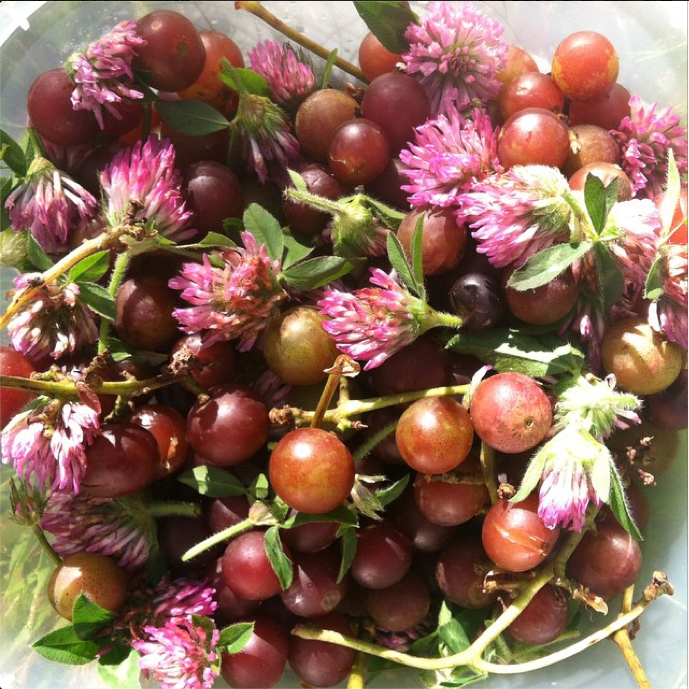
Wild grapes are the original grape and contain seeds which are the most nutritious part. Don't bother buying grape seed extract, just eat grape seeds. Like extra virgin olive oil, the antioxidants in grapes lower cholesterol, lowers blood pressure, strengthen blood vessels; are anti cancer, antinflammatory and are low glycemic.
Red clovers are mild in flavor, found about everywhere and are the perfect wild food balance to the intensity of these juicey grapes. They contain many valuable nutrients such as calcium, chromium, magnesium, niacin, phosphorus, potassium, thiamine, and vitamin C. Traditionally they are known to be antispasmodic, alterative, antitumor and expectorant. Their anti tumor effects are seen when blended with burdock root. At home we have always used red clover in herbal infusions in cold and flu remedies and especially if a wet cough is present; but these little flowers are gaining popularity in treating menopausal symptoms as well.
These are perfect in fruit or vegetable salads, either way, if you see something, pick something ;)
Tuesday, September 16, 2014
Sumacade

fill with cold water
cap it tight
shake it up
i like to make this infusion in the day time and set my jar in the sunlight.
in about an hour, strain it out
add a little honey
enjoy!
Subscribe to:
Posts (Atom)